Since the New Year, two serendipitous irresolutions have been bringing me joy and revitalization. These happenstance gifts came at just the right time, finding me before I could find them.
First, a friend brought back a set of guided mindfulness meditation CDs by Jon Kabat-Zinn from the States and shared them with me. More accurately, it is a 4-CD set of audio guided mindfulness exercises, including "Body Scan Meditation," "Mindfulness Yoga 1," "Sitting Meditation," and "Mindfulness Yoga 2." I just finished up the fourth CD (Mindfulness Yoga 2), and it's been a pleasure to go through the CDs one by one, trying each of the different techniques. The approach is gentle, and Zinns voice is warm and soothing (to the point of somnolence...I've gotten drowsy and almost nodded off during 2 of the 4 sessions.) Though I've got a long way to go with incorporating mindfulness into my daily life, I really like this simple and user-friendly format. As my jazz teacher used to say in high school, the more you learn about something the more you realize you don't know. In that regard, I've learned that I mostly seek mindlessness by habit. But I have also learned that it's possible to be conscious of which behaviors encourage mindlessness and which allow you to fully embrace the present moment. Even after just four sessions, I notice myself becoming more aware of moments in my daily routine that I would previously have ignored. Whereas I used to consider mindfulness a dull chore, I've found some joy in watching my thoughts or my body or tuning into the sky for a few moments. So I'm slowly discovering that mindfulness can be fun.
The second chance occurrence was an encounter with a friend of a friend who is traveling around the world studying electronic music and art. Her blog is here: http://korilisa.wordpress.com/ Can't really begin to describe how "cool" her work is, except that I'm filled with admiration (and the slightest bit of envy ;) for her. She's also interested in educating people and sharing what she knows in a way that's both generous and patient. So it was through this encounter that I built my first electronic instrument (with substantial help and instruction from her). It's a basic oscillator with standard components. Yesterday, I embarked on my second adventure by going and getting some more parts and then copying this how-to video: http://www.ehow.com/videos-on_3167_build-synthesizer.html. Though I've been interested in pursuing this sort of project for a long time, I've never gotten anything off the ground. Then, with a soldering iron thrust into my hands and all the bits and pieces laid out before my eyes, how could I say no? It just happened, and now I find myself getting excited about potentiometers and capacitors, words that I thought were just techno-babel for sci-fi movies a couple weeks ago.
Though both of these life-projects are in their nascent stages, I hope they will continue to bear fruit well into the future. They go to show that a little giving, a small random act of kindness, can (potentially) go a long way.
Finally, I can't help but drawing a connection between the two, even if I'm grasping at straws. The brain (which one might safely call "the mind") is itself a set of enormously complex circuits. In comparison, the circuits that I'm fiddling with on my newly purchased bread board are so simple as to be totally negligible. But the connection is that, just like a series of simple circuits or simple wave-forms that are added together to make complex circuits and complex wave-forms for music, the brain's circuits can be rewired and integrated to form new cognitive patterns. I'm kind of grossly delighted by the idea of soldering the self, unhinging one part of the mind and reconnecting it to another. This is much easier said than done, and takes a lot of effort, conscious planning and especially mindfulness to execute. But there is a kind of joy in looking at one's life as a circuit experiment, taking each isolated module and forging new connections. Isn't that what meaning is all about? For example, if I take my morning shower and merge it with singing, I might create an opera in my bathtub. Or if I connect my beers with books, (http://www.beersforbooks.org), or video games with education, I might be able to put a new spin on my so-called "vices." To me, this is the excitement of the 21st century. The possibility of creating an infinite number of new networks to bring fresh and creative solutions to human problems. The remixing and reconnecting of networks is, hopefully, still in its infancy. Just as I've managed to mix (perhaps haphazardly) circuits and mindfulness in this post, so too can any number of different ideas be re-bundled to provoke innovation and creativity.
As acknowledged above, there is a long way to go, and I'm certainly getting ahead of myself. The results of this kind of experimentation could also have devastating consequences (think of the hippies!), which underscores the need for a contemplative process to guide powerful tools and insights. For now, let me just say thanks to those who have helped make my January meaningful. Love to you all, and I hope you're enjoying the present and nurturing the future.
Monday, January 24, 2011

Tuesday, January 11, 2011
Sounds of the Nagasaki Atomic Bomb Memorial Museum
I recently returned from a trip to visit family friends in Nagasaki with my sister. We had a great time: our friends were wonderfully generous hosts, and we packed in tons of sight-seeing. For the second time, I visited the Nagasaki Atomic Bomb Museum, a moving (disturbing and inspiring) experience. Upon entering the museum, I decided to make a mental note of the sounds I experienced throughout the exhibit hall, which commemorates the bombing and its aftermath. I divided the sounds into possible "tracks" for a recording, though they overlap as you walk through the museum. Here is what I noted:
1. Ticking clock. The first part of the exhibit highlights events leading up to the bombing on August 9, 1945.
2. Ominous music. Strings alternate between minor and dissonant harmonies. The next room commemorates the day of the bombing and the wasteland created around the epicenter.
3. Explanatory video. Accompanied by a 3D map of the city, this video explains the facts (historic and scientific) about the bombing and its immediate aftermath.
4. Tour guides (Japanese and Chinese). Two or three tour groups browsed the artifacts which document the effects of the bomb in different locations around the city. The intense energy at the hypocenter generated a massive blast of heat that caused stone tiles to blister and bubble, glass bottles to melt together, and shadows to be imprinted onto wooden houses and fences. Many of the deaths and injuries from the bomb were caused by severe burns, some of which developed much later after the attack. The long-term effects of radiation are also documented with explanations about various diseases caused by exposure, as well as a time-line of deaths caused by radiation-related illnesses. Tour guides give additional explanation to groups.
5. Survivor testimonials. Interactive TV monitors allow visitors to listen and watch survivors give their accounts of the bombing and make appeals for peace. My sister and I watched an account by a woman who was crushed in the rubble and suffered severe injuries. She spoke in Japanese, and we read English subtitles.
6. Museum closing announcement. The announcement was in Japanese, followed by English, accompanied by upbeat music.
One of the most valuable parts of the museum is a timeline of the nuclear age, which describes world events, the spread of nuclear weapons, and the spread of the peace movement worldwide. This is a great overview of the Cold War and anti-nuclear movement.
For more information about the museum in English, follow the link below.
http://www1.city.nagasaki.nagasaki.jp/peace/english/index.html
1. Ticking clock. The first part of the exhibit highlights events leading up to the bombing on August 9, 1945.
2. Ominous music. Strings alternate between minor and dissonant harmonies. The next room commemorates the day of the bombing and the wasteland created around the epicenter.
3. Explanatory video. Accompanied by a 3D map of the city, this video explains the facts (historic and scientific) about the bombing and its immediate aftermath.
4. Tour guides (Japanese and Chinese). Two or three tour groups browsed the artifacts which document the effects of the bomb in different locations around the city. The intense energy at the hypocenter generated a massive blast of heat that caused stone tiles to blister and bubble, glass bottles to melt together, and shadows to be imprinted onto wooden houses and fences. Many of the deaths and injuries from the bomb were caused by severe burns, some of which developed much later after the attack. The long-term effects of radiation are also documented with explanations about various diseases caused by exposure, as well as a time-line of deaths caused by radiation-related illnesses. Tour guides give additional explanation to groups.
5. Survivor testimonials. Interactive TV monitors allow visitors to listen and watch survivors give their accounts of the bombing and make appeals for peace. My sister and I watched an account by a woman who was crushed in the rubble and suffered severe injuries. She spoke in Japanese, and we read English subtitles.
6. Museum closing announcement. The announcement was in Japanese, followed by English, accompanied by upbeat music.
One of the most valuable parts of the museum is a timeline of the nuclear age, which describes world events, the spread of nuclear weapons, and the spread of the peace movement worldwide. This is a great overview of the Cold War and anti-nuclear movement.
For more information about the museum in English, follow the link below.
http://www1.city.nagasaki.nagasaki.jp/peace/english/index.html
Thursday, December 9, 2010
RescueTime and Privacy Concerns
I thought I'd go ahead and try the personal productivity manager, RescueTime, mentioned in a previous post. I thought this would be a good way for me to passively monitor my web browsing and computer usage. But I took a look at the privacy policy and got scared off.
What concerns me about RescueTime is that they are selling your information. Not your individual information, but the collective information collected from all of its users about their online behavior. According to their privacy policy: "We may sell, rent, or share information about user behavior in the aggregate only. For example, we could share information like, "which day of the week do people spend the most time in front of their computer?""
For starters, I thought the software was only a tool FOR ME. I didn't think it would collect my browsing information, let alone contribute it to a database and sell it. It's not the creation of a database of internet user behavior that I have a problem with. It's the fact that this information is monetized and used for a for-profit company. I'd be happy to participate in research where information about my computer use was recorded and aggregated into a database and analyzed. No problem. But selling the results from this research seems unethical. Why should only those who can pay know about people's computer habits?
Some might argue that this research is costly, requiring time, energy and money. But couldn't an open-source/crowd-source project with the same aim be just as effective? Why does this research have to result in a for-profit business model? Is there some free-ware out there that allows you to monitor your computer usage and keep the records for yourself? I wanna know!
What concerns me about RescueTime is that they are selling your information. Not your individual information, but the collective information collected from all of its users about their online behavior. According to their privacy policy: "We may sell, rent, or share information about user behavior in the aggregate only. For example, we could share information like, "which day of the week do people spend the most time in front of their computer?""
For starters, I thought the software was only a tool FOR ME. I didn't think it would collect my browsing information, let alone contribute it to a database and sell it. It's not the creation of a database of internet user behavior that I have a problem with. It's the fact that this information is monetized and used for a for-profit company. I'd be happy to participate in research where information about my computer use was recorded and aggregated into a database and analyzed. No problem. But selling the results from this research seems unethical. Why should only those who can pay know about people's computer habits?
Some might argue that this research is costly, requiring time, energy and money. But couldn't an open-source/crowd-source project with the same aim be just as effective? Why does this research have to result in a for-profit business model? Is there some free-ware out there that allows you to monitor your computer usage and keep the records for yourself? I wanna know!
Sunday, December 5, 2010
Getting Ahead of the News Cycle
Today there was a protest in Shinjuku. According to early reports, about 160 people gathered to stop traffic, speak out against war, and voice their support for the citizens of Okinawa, who have again demonstrated through elections that they don't want the Futenma military base relocated within Okinawa. There were clowns:


A quick google search for 新宿デモ (Shinjuku demo) revealed some old links from a labor newspaper announcing the protest and giving directions to the event, along with a tangentially related blog post.
I had just heard about the demonstration this afternoon in an email from a Tokyo-based group, Takae Yuntaku. (They are working to prevent a U.S. military helipad from being built in the small Okinawan village of Takae). Info about the event appeared on various blogs:
http://takae.ti-da.net/
http://d.hatena.ne.jp/hansentoteikounofesta09/
This was the sixth in a series of protests in favor of the abolition of the base. Here is some video from previous protests:
So I found out about the protest about an hour before it started. Then, as it was going on, a recent Facebook friend Tweeted out "good turnout for the protest. blocking traffic in shinjuku" or something to that effect, and it showed up on his facebook feed. Finally, I wanted to hear about the event. I turned on 素人の乱 (Shiroto no Ran)'s weekly webcast, and there was some mention of it, but mostly talking about AKB48 and how none of the girls are their type. So I checked another friend's facebook page who is active in independent media, and sure enough, he had updated it with some news and pictures from the protest.
I had heard about Twitter and other social networking sites being used to get ahead of the news cycle, but now this is the first time I've experienced it. Maybe it also has to do with the fact that there probably won't be much coverage of this event in the mainstream press. But amongst interested parties the news has come out quickly. From this experience, I can see how these social networks can give protesters a better sense of connection. Even though I couldn't make it to the protest, I feel better informed about and connected with those who did.
Where do I stand on the Futenma issue? Indeed it's complicated, but ultimately I must object to the indirect militarization of Japan. In Japan's constitution, Article 9 prohibits a standing military, although Japan maintains its own self-defense force. In effect, the U.S. military presence in Okinawa and throughout Japan amounts to a standing military. As tensions between North and South Korea escalate, the time is right for diplomacy, not war games. I find it difficult to speak out on this issue, especially since I know several people in the military. But as an American, I can't stand by in good conscience and allow the U.S. to become involved in an avoidable war with North Korea in the way of Iraq and Afghanistan. I didn't make it to the protest this week, but I will get the word out and try to make the next one.
12/7 update - video from the event. Thanks OurPlanet-TV!


A quick google search for 新宿デモ (Shinjuku demo) revealed some old links from a labor newspaper announcing the protest and giving directions to the event, along with a tangentially related blog post.
I had just heard about the demonstration this afternoon in an email from a Tokyo-based group, Takae Yuntaku. (They are working to prevent a U.S. military helipad from being built in the small Okinawan village of Takae). Info about the event appeared on various blogs:
http://takae.ti-da.net/
http://d.hatena.ne.jp/hansentoteikounofesta09/
This was the sixth in a series of protests in favor of the abolition of the base. Here is some video from previous protests:
So I found out about the protest about an hour before it started. Then, as it was going on, a recent Facebook friend Tweeted out "good turnout for the protest. blocking traffic in shinjuku" or something to that effect, and it showed up on his facebook feed. Finally, I wanted to hear about the event. I turned on 素人の乱 (Shiroto no Ran)'s weekly webcast, and there was some mention of it, but mostly talking about AKB48 and how none of the girls are their type. So I checked another friend's facebook page who is active in independent media, and sure enough, he had updated it with some news and pictures from the protest.
I had heard about Twitter and other social networking sites being used to get ahead of the news cycle, but now this is the first time I've experienced it. Maybe it also has to do with the fact that there probably won't be much coverage of this event in the mainstream press. But amongst interested parties the news has come out quickly. From this experience, I can see how these social networks can give protesters a better sense of connection. Even though I couldn't make it to the protest, I feel better informed about and connected with those who did.
Where do I stand on the Futenma issue? Indeed it's complicated, but ultimately I must object to the indirect militarization of Japan. In Japan's constitution, Article 9 prohibits a standing military, although Japan maintains its own self-defense force. In effect, the U.S. military presence in Okinawa and throughout Japan amounts to a standing military. As tensions between North and South Korea escalate, the time is right for diplomacy, not war games. I find it difficult to speak out on this issue, especially since I know several people in the military. But as an American, I can't stand by in good conscience and allow the U.S. to become involved in an avoidable war with North Korea in the way of Iraq and Afghanistan. I didn't make it to the protest this week, but I will get the word out and try to make the next one.
12/7 update - video from the event. Thanks OurPlanet-TV!
Saturday, December 4, 2010
A Commitment to Nonviolence and Recycling
A Commitment to Non-Violence
Last week I was graced with what I like to call a "moment of lucidity" - a time when truth or beauty just present themselves out of nowhere. The revelation: a commitment to non-violence. As I see it, there are two types of violence: 1) physical violence 2) mental or emotional violence.
From this moment, I commit myself to refraining from physical violence toward human beings, and trying to spread this doctrine to create a more peaceful world. As for the second, more abstract forms of violence, it is more complicated, so I want to focus for now on just eliminating physical violence. By adhering to this basic principle, individuals can make a big change for peace.
I also commit myself to learning more about the ethics of war and peace. One of the classes that convinced me to major in religion was "War and Peace Through Religious Perspectives." I'd like to revisit the contents of this class, and gain a better understanding of how movements for pacifism and non-violence become successful in all wisdom traditions - from atheists to agnostics, from Jews to Jains.
Though it is easy for me to refrain from violence - my country doesn't have a draft (at the moment) and I don't live in a war-torn city or an area plagued by gang violence. But I want to use this commitment to non-violence to create social change through civil disobedience, and educating others about this possibility. If you can get a kid in South East D.C. to decide not to buy a gun, or a kid in Colorado to refrain from shooting up his classmates, you've done something important.
Later in the week, I was inspired by my great uncle, Ted Nace. He was recently arrested for protesting outside a shopping center against an Israeli cosmetics company which benefits from the exploitation of resources in Palestine. He's over 80 years old. Go Ted! You are a real inspiration.
You can see video of about his arrest here:
http://www.krdo.com/video/25943611/index.html
http://www.krdo.com/video/25935874/index.html
A Week of Recycling
On a slightly more practical note, I really, REALLY need to take out my recycling. This is a reminder to myself to get the schedule this week and remember to bring out my separated recyclables on the appropriate day. Also, I gotta start carrying my water bottle and stop buying PET bottles. They don't recycle well. I also gotta bring some clothes to the nearby recycle shop, or perhaps 素人の乱 (Shiroto no Ran)'s recycle shop.
Great podcast on "upcycling" (i.e. re-using) from "To The Best of Our Knowledge" last week. Check it out.
http://www.wpr.org/book/101121b.cfm
Another good one on consumerism:
http://www.wpr.org/book/091129a.cfm
Last week I was graced with what I like to call a "moment of lucidity" - a time when truth or beauty just present themselves out of nowhere. The revelation: a commitment to non-violence. As I see it, there are two types of violence: 1) physical violence 2) mental or emotional violence.
From this moment, I commit myself to refraining from physical violence toward human beings, and trying to spread this doctrine to create a more peaceful world. As for the second, more abstract forms of violence, it is more complicated, so I want to focus for now on just eliminating physical violence. By adhering to this basic principle, individuals can make a big change for peace.
I also commit myself to learning more about the ethics of war and peace. One of the classes that convinced me to major in religion was "War and Peace Through Religious Perspectives." I'd like to revisit the contents of this class, and gain a better understanding of how movements for pacifism and non-violence become successful in all wisdom traditions - from atheists to agnostics, from Jews to Jains.
Though it is easy for me to refrain from violence - my country doesn't have a draft (at the moment) and I don't live in a war-torn city or an area plagued by gang violence. But I want to use this commitment to non-violence to create social change through civil disobedience, and educating others about this possibility. If you can get a kid in South East D.C. to decide not to buy a gun, or a kid in Colorado to refrain from shooting up his classmates, you've done something important.
Later in the week, I was inspired by my great uncle, Ted Nace. He was recently arrested for protesting outside a shopping center against an Israeli cosmetics company which benefits from the exploitation of resources in Palestine. He's over 80 years old. Go Ted! You are a real inspiration.
You can see video of about his arrest here:
http://www.krdo.com/video/25943611/index.html
http://www.krdo.com/video/25935874/index.html
A Week of Recycling
On a slightly more practical note, I really, REALLY need to take out my recycling. This is a reminder to myself to get the schedule this week and remember to bring out my separated recyclables on the appropriate day. Also, I gotta start carrying my water bottle and stop buying PET bottles. They don't recycle well. I also gotta bring some clothes to the nearby recycle shop, or perhaps 素人の乱 (Shiroto no Ran)'s recycle shop.
Great podcast on "upcycling" (i.e. re-using) from "To The Best of Our Knowledge" last week. Check it out.
http://www.wpr.org/book/101121b.cfm
Another good one on consumerism:
http://www.wpr.org/book/091129a.cfm
Sunday, November 21, 2010
Cultural Action Event at Waseda
This event at Waseda last night was super cool - engaging and fun. From 6-8 pm was a panel discussion entitled "Cultural Action: Frontiers or Archipellagos?," followed by a party at a nearby music cafe, Sabaco. The event was organized by Ian Condry (MIT) [イアン コンドリー(MIT)] and Toshiya Ueno (Wakou Daigaku) [上野俊哉(和光大学)]. Cultural action refers to (counter)cultural activities amongst Japanese youth which blur the lines between work/play, the political/apolitical, activism/frivolity, and (pop)culture/media/music/sports/lifestyle. "Cultural Typhoon" at Komazawa Gakuen and "Alternative Politics" at Sophia University's Institute for Comparative Cultural Studies were other 2010 academic conferences which explored similar themes and overlapping protest movements, such as Shirotou no Ran, Okinawan peace activists, situationalists and the freeter (フリーター) movement. In this post, I'll summarize the panel along with my impressions, report on the party, and reflect on the exciting new frontiers of cultural action with the potential to affect social, political, cultural and economic change.
Panel
1) Atsuhi Yamamoto (Sophia University) - "Nagano Snowboarders"
山本 敦久(上智大学)「長野スノボ:アンチからアントレ」
The presentation began with a recent video produced by Nagano snowboarders. Typical of skateboard and snowboard films, the video begins with a quick-cut introduction of daring runs and mind-boggling tricks set to driving (in this case rhythmically complex) rock music. After a few minutes, the visual context was set and the presenter turned to cultural context.
 Since the late 1970s, snowboarders in Nagano have developed a culture centered around their love of riding. For them, snowboarding is more than just a hobby or winter sport. It is the backbone of their lifestyle, livelihood and community. To support this passion and create more sustainable forestry practices, they embarked on an entrepreneurial endeavor entitled "GREEN LAB" to make environmentally friendly wood-core snowboards and skis. Their business model is based on sustainable management of Nagano's artificial forests. In a statement on their website, they explain the concept behind their business: "Proposal for the establishment of LOHAS (Lifestyles of Health and Sustainability") in the forest of Shinshu (Nagano)."
 The GREEN LAB project blends business, environmental action, education, eco-tourism/recreation, an alternative lifestyle, sports, and culture. The project extends into all corners of life - from teaching children about woodworking and the environment to musical events and bar culture. This is the first example of hybridized cultural action from this panel.
It is economically significant because the company may rival such big brand snowboard makers as Burton, whose authenticity is questioned by the notion of "selling out." Is Burton just another capitalist company concerned only with it's bottom line? Though GREEN LAB undoubtedly participates in a capitalist business market, their goals are explicitly multifaceted, rather than the single-minded pursuit of profit. As Professor Ueno commented, in Naomi Klein's terms, the group is aiming for a "new logo, not no logo," i.e. a brand that emphasizes environmental awareness and sustainability. The extent of the impact of this business model based on hybrid incentives remains to be seen.
I'm tempted to compare this cultural phenomenon with another eco-tourist endeavor in Minamikami, Gunma, The Alpine Lodge, which has partnered with Parties 4 Peace of Tokyo to produce Alpine Tech Fest in January. Now in its sixth year, the event combines snowboarding, eco-tourism and education with underground house/techno for a three day event, and Parties 4 Peace offers a weekend package deal including bus fare from Tokyo, accommodations, and party. Though I must disclose my bias as a supporter of Parties 4 Peace, this event and more general eco-tourism activities at the Alpine Lodge may offer a fruitful site of comparison for the (sub)cultural action between snowboarders in Nagano and Gunma.
2) Shin Futatsugi (writer, activist) - "Shiroto no Ran in Koenji"
二木信( ライター)「 素人の乱」の高円寺
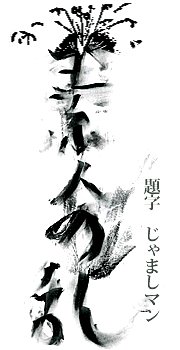 Shin described his background as a member of Shiroto no Ran and the group's activities. Though known for its creative political actions in Tokyo, the group has also become a community staple in Koenji, Tokyo, where it runs a recycle shop and is active in the local business community. The group also produces an online radio show. It is well known amongst cultural studies academics and radical leftists in Tokyo. The group was the focus of a presentation at the "Alternative Politics" conference at Sophia last Spring.
 Shin is a rapper and has been involved with the group in this capacity, though I'm not sure about the full extent of his involvement as a member. I haven't heard his rap, but I'm guessing it's pretty political. He described the hip hop community in relationship to concepts such as "cool" and "underground." He is also involved in an annual Shiroto no Ran event "Sound Clash," which is a music battle pitting hip-hoppers, house/techno DJs, guitarists, etc. against each other to see who's the best.
Like the Nagano snowboarders, Shiroto no Ran's activities are multifaceted and multipurposed. Both groups combine "play" and "labor" in their cultural action, and some of the professors at the panel referred to this amalgamation as "playbor" (プレーバー). Play+Labor=Playbor. プレー (遊び) + レーバー (労働) = プレーバー.
This is the central theme that I took away from the event. This generation of activists was raised on video games and cartoons, and we expect fun and entertainment even when we work. The effectiveness of combining play and labor is very much up in the air, but I want to believe that it is possible to have fun and work for social justice at the same time. For more on this theme, see previous post on Beer for Books and Parties 4 Peace, as well as reflections below.
3) Toko Tanaka (Waseda University) - "Girls' Culture and Cosplay"
田中東子(早稲田大学)「ガールズ文化とコスプレ」
 What is the relationship between feminism and cosplay? Cosplay stands for costume play, a cultural phenomenon which emerged out of the role-playing rituals at North American sci-fi conventions and has become a pastime/subculture among some Japanese youth. Now, many girls convene at various locations in Tokyo on weekends and dress up as their favorite characters. They are influenced by a variety of pop-culture images, from anime and manga characters to Disney movies.
 My main understanding of Tanaka-sensei's presentation is that cosplay gives girls (and some boys) a chance to escape from their everyday persona/socially prescribed gender roles and enact a new vision of themselves. This action might not be explicitly political or described in terms of feminism, but, consciously or unconsciously, participants are engaged in cultural action as members of a subculture/in-group. This leads again to the question, "What is political?" and whether action that is not intended to be specifically political can have political/social consequences.
4) Members of Riot Love Letter (RLL) (media activists) - "The State of Culture Jamming"
RLLのIntellipunk「文化的『介入』の現在」
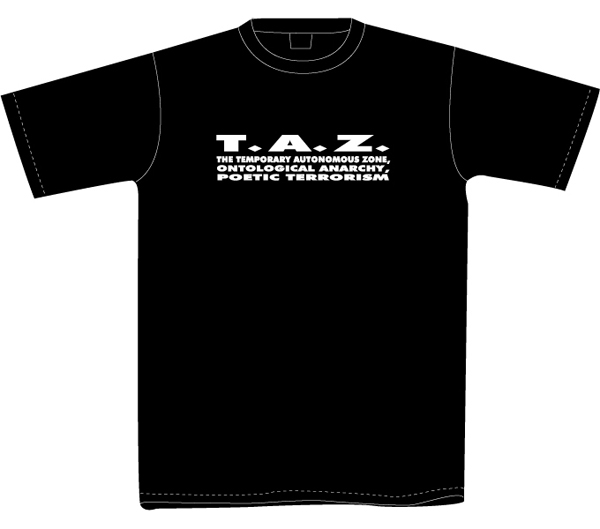
Inspired by the culture jamming activities of groups such as "Ad Busters," this three-member collective remixes pop culture designs and images to produce T-shirts which act as a springboard for provocative fashion/political/cultural discourse. Culture jamming is the remixing/reinterpretation/defacement of corporate advertising symbols and logos to create an alternative message. The group also engages in creative protests/demonstrations, and they suggested "Radical Left Laughter" as another name for their group.
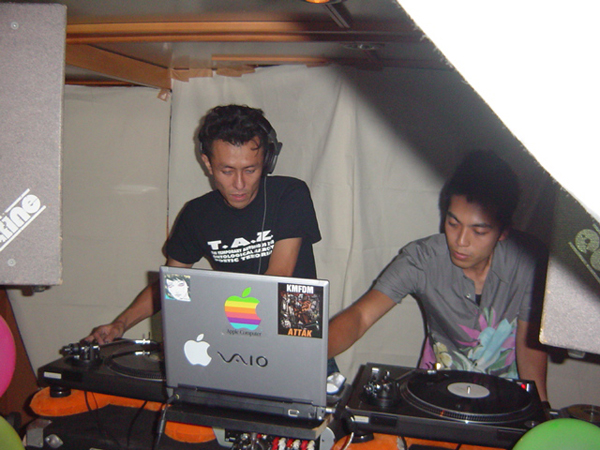
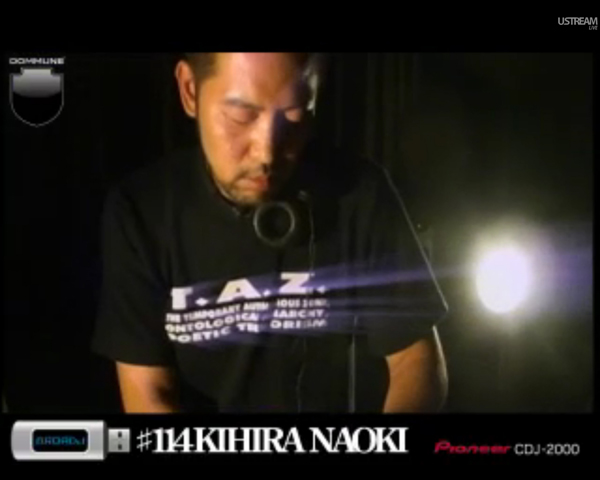
Their presentation consisted of a perusal of their T-shirt designs and explanations of the backstories behind each T-shirt. T-shirts are for sale on their website, and by clicking on the [Read More] links visitors can learn about the context for each design. For example, the "T.A.Z. - Total Autonamous Zone" (Hakim Bey) T-shirt can be seen here rocked by Tokyo DJs.
And graffiti artist Kitou Seishi used one of their designs in a 2007 project in Palestine called "Wonderwall." Here's a video edited by the RLL members about the Wonderwall project featuring their design:
When I watched this video, I thought "The revolution will not be televised, but it might be on YouTube." (I thought I came up with this clever turn of phrase, but a quick Google search reveals that poet, professor and NPR commentator Marion Winik coined it as a title of her poem of the same name. However, the phrase also appears as a comment on a facebook group wall dating to 2008.)
In other words, culture jamming/remixing has the potential to create Temporary Autonomous Zones where corporate culture is not the dominant semiotic system. Though YouTube may becoming increasingly corporate since it's acquisition by Google, the democratic principle of anyone posting a video with equal opportunity for viral meming is one of the revolutionary principles of the Internet at large. This principle, which makes the Internet a valuable cultural frontier, is threatened by such perils as the proliferation of invasive advertising and attempts to innovate at the expense of net neutrality. In this regard, the internet may soon become an archipelago of cultural action, eclipsed by the dominant forces which control economic, technological, political, and cultural life.
Party

After the panel, the event transitioned to a DJ party at small music cafe and bar, Sabaco. At the beginning of the party, there was some time for discussion and Q+A, with Ian Condry moderating questions/comments at two mics, and Toshiya Ueno DJing quietly in the background. Though the panel was intellectually stimulating and a challenge to my Japanese listening comprehension, it was nice to get into a more social environment and embrace the "work/play" amalgamation we had just been talking about in the University classroom. Ueno-sensei played house and Ian played Japanese hip-hop, the subject of his 2006 book. It's recently been translated into Japanese. Props to them for spinning thoughtful jams and creating a great atmosphere.
Reflections
The changing nature of play and labor engendered by technology and culture has profound consequences to the extent that it might be called a paradigm shift. This shift has given rise to a heated debate/discourse about the appropriate relationship of technology and society. According to most indicators, we are, at present, at just the beginning of the information age. Therefore, further study of this debate is certainly warranted. The question at large is how to live a good life in the 21st century. Thus, the development of cultural action which cultivates a positive data-wisdom continuum, and by extension a just and peaceful world, is an exciting and important frontier.
Marshall McLuhan remarked that TV was causing society to "re-tribalize." As opposed to the culture of individuality created by the "man of the book," TV was a more communal activity in which millions of people took part at the same time. Though perhaps problematized by postcolonial cultural anthropologists, the term "tribe/tribal" was used by some members of the panel last night in the context of groups such as Shiroto no Ran and RLL. The term is also used in music. For example, Ueno-sensei's DJ name is "Toshiya the Tribal," and groups such as Tribe of Ischaar and Tribe Called Quest use the term to indicate their solidarity as a musical unit or crew. These subcultural units are reorganizing themselves around new concepts or ideas which lead to alternative lifestyles. Undoubtedly, a sustainable world requires that some alternatives to the current economic and cultural landscape are presented. This is the exciting prospect of hybrid culture and hybrid economies, presented by Lawrence Lessig in his book Remix.
I wonder if breaking down the play/labor dichotomy is a necessary phase in transitioning to a "re-tribalized" society where everyone participates in some sort of alternative lifestyle/economic system. Already, it is clear that everyone in the globalized world is somehow affected by a subcultural movement. If you don't do cosplay or watch anime or listen to hip-hop or read sci-fi, chances are good that you know someone who does. For those who are already living in a hybrid world where culture and subculture interact in a complex way, what is the next step? Do groups like the Nagano snowboarders demonstrate that total commitment to a cause/lifestyle is the next logical step for cultural progressives?
Personally and in this blog, I've explored the concept of integration. That is, finding ways to become a whole person, despite this fractured state of hybridity which seems to characterize contemporary identity and even existence. A recent edition of Wisconsin Public Radio's "To the Best of Our Knowledge" podcast entitled "Integration Stories" shifted my thinking about integration and holism. Though the podcast deals with stories of racial integration in the historical context of segregation (not psychological or spiritual integration of individuals), it reminded me that integration/assimilation is not the only approach to diversity. Another approach is pluralism.
During my undergrad studies as a religion major, I was drawn to the work of Harvard professor Dianna Eck, who established the Pluralism Project, documenting America's religious diversity. Why not apply this spirit of pluralism to the identity issues presented by technology? That is, why not take a pluralistic stance when it comes to the multifaceted, multipurposed, hybrid manifestations of one's own identity? Though I think holism and balance are important, is there also value in respecting certain socially prescribed roles? This pluralistic view of identity and the self, is, I believe, an important step in maturity. The question remains: if one embraces one's own hybrid identity, how can one leverage it to maximize social and political change, to work for equality and justice? What is the value of "re-tribalizing," and what are the dangers? Is a pluralistic notion of the self diametrically opposed to an alternative lifestyle? How can cultural action/actors keep the frontier open, rather than allowing it to be reduced to archipelagos?
Wednesday, November 10, 2010
2 Parties 4 Peace
(sorry, this post is a little late.)
11/8 - Last weekend was filled with partying, but it wasn't your typical carousal. Saturday night was the Patagonica DJ Contest presented by Parties 4 Peace, and on Sunday two friends threw a collaborative birthday party with Beers for Books and Room to Read and JEN. Details below:
Parties 4 Peace
Created by Peace Boat staffer, Emilie McGlone, this organization is dedicated to "people making a better world through music and dance." Proceeds from their events are donated to environmental and social justice causes. The Patagonica Project is one such cause, aimed at preserving Patagonica, Chile.
Beers for Books
For every beer you buy, a dollar (100 yen) of the proceeds goes to printing children's books to promote literacy in developing countries.
Here's a B4B event from 2009:
11/8 - Last weekend was filled with partying, but it wasn't your typical carousal. Saturday night was the Patagonica DJ Contest presented by Parties 4 Peace, and on Sunday two friends threw a collaborative birthday party with Beers for Books and Room to Read and JEN. Details below:
Parties 4 Peace
Created by Peace Boat staffer, Emilie McGlone, this organization is dedicated to "people making a better world through music and dance." Proceeds from their events are donated to environmental and social justice causes. The Patagonica Project is one such cause, aimed at preserving Patagonica, Chile.
Beers for Books
For every beer you buy, a dollar (100 yen) of the proceeds goes to printing children's books to promote literacy in developing countries.
Here's a B4B event from 2009:
Subscribe to:
Posts (Atom)